When a Door Event Has No Usable Video: A Modern Security Gap
Blog
•
minute read
The Moment Everything Depends on Video
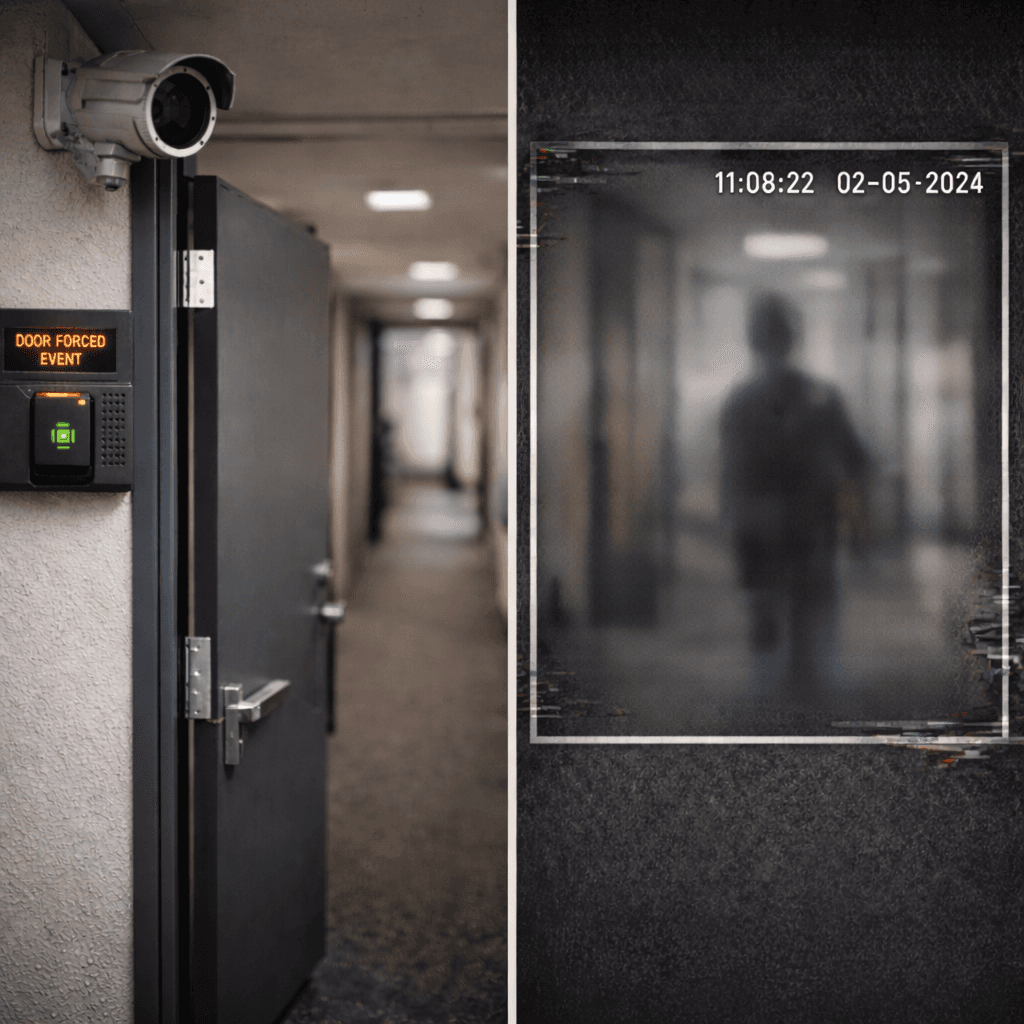
A door opens. An alarm triggers. An access control event is logged.
Someone pulls up the camera feed to see what actually happened… and there’s nothing useful to look at.
Maybe the image is blurry. Maybe the lens is covered. Maybe the camera shifted and is now pointing at the ceiling. Maybe the stream froze hours ago but still shows “online.” On paper, the system worked. In reality, it failed at the one moment it mattered.
This is one of the quiet but growing gaps in modern security: a verified door event with no usable video.
Why “Online” Doesn’t Mean Reliable
Most organizations assume they’re covered because the basics are in place. Doors are monitored. Cameras are installed. The VMS says devices are online. Everything looks healthy from a distance.
But uptime does not equal reliability.
A camera can be powered on and still deliver unusable evidence. And most teams only discover that when an incident is already underway. That’s when the questions start. Can we see the person? Can we confirm what happened? Can we trust this footage?
Too often, the answer is no.
A Problem That Grows with Scale
As security systems expand, this problem becomes harder to control. More sites, more cameras, more vendors, more network layers, and more points of failure all stack up.
Traditional monitoring tools were built to check if a device responds, not if the image itself is clear, accurate, and meaningful. They can tell you a camera is connected, but they can’t tell you whether it’s actually doing its job.
And most organizations only learn that lesson during an investigation.
When Video Fails, the Risk Multiplies
When a door event has no usable video, the consequences are more than technical.
Investigations stall. Compliance becomes harder to prove. Liability increases. Trust in the system erodes. In environments like transportation, healthcare, government facilities, and banking, missing or unusable video isn’t just frustrating. It’s operational risk.
Security teams are left trying to explain what happened without the one thing everyone expects to see: clear visual evidence.
Camera Health Is More Than Device Status
What’s missing in most security programs is continuous confidence in camera health, not just camera status.
Camera health means knowing the image is usable before something goes wrong. It means catching blurred focus, obstructed lenses, poor lighting, frozen streams, timestamp errors, or cameras that have slowly drifted out of position.
These issues don’t usually fail all at once. They creep in quietly until the day they matter most.
Shifting from Reactive to Preventative
This is where image-level intelligence changes the conversation.
With EyeOTmonitor’s ImageAssure, camera integrity is evaluated continuously, not just when someone happens to look. Instead of discovering after an incident that video wasn’t usable, teams can detect visual degradation early and fix it before it turns into a blind spot.
The result is a different operational mindset. Door events are no longer just log entries. They come with confidence that video will actually tell the story. Security becomes preventative instead of reactive, and investigations become faster, clearer, and more defensible.
From Events to Evidence
The future of physical security isn’t just more cameras or more alerts. It’s better assurance that what those systems produce is trustworthy.
Because a door event without usable video isn’t just a technical issue. It’s a broken promise of visibility.
Modern security requires more than knowing something happened. It requires seeing what happened clearly.
The Gap Security Teams Can No Longer Ignore
If your system can tell you that a door opened but can’t show you what happened, you don’t really have situational awareness. You only have partial truth.
And partial truth is one of the most dangerous gaps in security.
Closing that gap means treating camera health with the same seriousness as door events themselves.
When events and evidence finally move together, security works the way it was always meant to.
The Moment Everything Depends on Video
A door opens. An alarm triggers. An access control event is logged.
Someone pulls up the camera feed to see what actually happened… and there’s nothing useful to look at.
Maybe the image is blurry. Maybe the lens is covered. Maybe the camera shifted and is now pointing at the ceiling. Maybe the stream froze hours ago but still shows “online.” On paper, the system worked. In reality, it failed at the one moment it mattered.
This is one of the quiet but growing gaps in modern security: a verified door event with no usable video.
Why “Online” Doesn’t Mean Reliable
Most organizations assume they’re covered because the basics are in place. Doors are monitored. Cameras are installed. The VMS says devices are online. Everything looks healthy from a distance.
But uptime does not equal reliability.
A camera can be powered on and still deliver unusable evidence. And most teams only discover that when an incident is already underway. That’s when the questions start. Can we see the person? Can we confirm what happened? Can we trust this footage?
Too often, the answer is no.
A Problem That Grows with Scale
As security systems expand, this problem becomes harder to control. More sites, more cameras, more vendors, more network layers, and more points of failure all stack up.
Traditional monitoring tools were built to check if a device responds, not if the image itself is clear, accurate, and meaningful. They can tell you a camera is connected, but they can’t tell you whether it’s actually doing its job.
And most organizations only learn that lesson during an investigation.
When Video Fails, the Risk Multiplies
When a door event has no usable video, the consequences are more than technical.
Investigations stall. Compliance becomes harder to prove. Liability increases. Trust in the system erodes. In environments like transportation, healthcare, government facilities, and banking, missing or unusable video isn’t just frustrating. It’s operational risk.
Security teams are left trying to explain what happened without the one thing everyone expects to see: clear visual evidence.
Camera Health Is More Than Device Status
What’s missing in most security programs is continuous confidence in camera health, not just camera status.
Camera health means knowing the image is usable before something goes wrong. It means catching blurred focus, obstructed lenses, poor lighting, frozen streams, timestamp errors, or cameras that have slowly drifted out of position.
These issues don’t usually fail all at once. They creep in quietly until the day they matter most.
Shifting from Reactive to Preventative
This is where image-level intelligence changes the conversation.
With EyeOTmonitor’s ImageAssure, camera integrity is evaluated continuously, not just when someone happens to look. Instead of discovering after an incident that video wasn’t usable, teams can detect visual degradation early and fix it before it turns into a blind spot.
The result is a different operational mindset. Door events are no longer just log entries. They come with confidence that video will actually tell the story. Security becomes preventative instead of reactive, and investigations become faster, clearer, and more defensible.
From Events to Evidence
The future of physical security isn’t just more cameras or more alerts. It’s better assurance that what those systems produce is trustworthy.
Because a door event without usable video isn’t just a technical issue. It’s a broken promise of visibility.
Modern security requires more than knowing something happened. It requires seeing what happened clearly.
The Gap Security Teams Can No Longer Ignore
If your system can tell you that a door opened but can’t show you what happened, you don’t really have situational awareness. You only have partial truth.
And partial truth is one of the most dangerous gaps in security.
Closing that gap means treating camera health with the same seriousness as door events themselves.
When events and evidence finally move together, security works the way it was always meant to.
See EyeOTmonitor in Action
Get real-time visibility into your entire security system. Walk through the platform with our team and see how it fits your environment.
Image Health
Infrastructure Monitoring
Discovery & Mapping
Analytics
Integrations
Resources
Get Started
Pricing
© 2026 by EyeOTmonitor


See EyeOTmonitor in Action
Get real-time visibility into your entire security system. Walk through the platform with our team and see how it fits your environment.
Image Health
Infrastructure Monitoring
Discovery & Mapping
Analytics
Integrations
Resources
Get Started
Pricing
© 2026 by EyeOTmonitor
See EyeOTmonitor in Action
Get real-time visibility into your entire security system. Walk through the platform with our team and see how it fits your environment.
Image Health
Infrastructure Monitoring
Discovery & Mapping
Analytics
Solutions
By Role
Regional ISPs
Systems Integrators
MSPs
Integrations
Resources
Get Started
Pricing
© 2026 by EyeOTmonitor